
How it works
Our technology
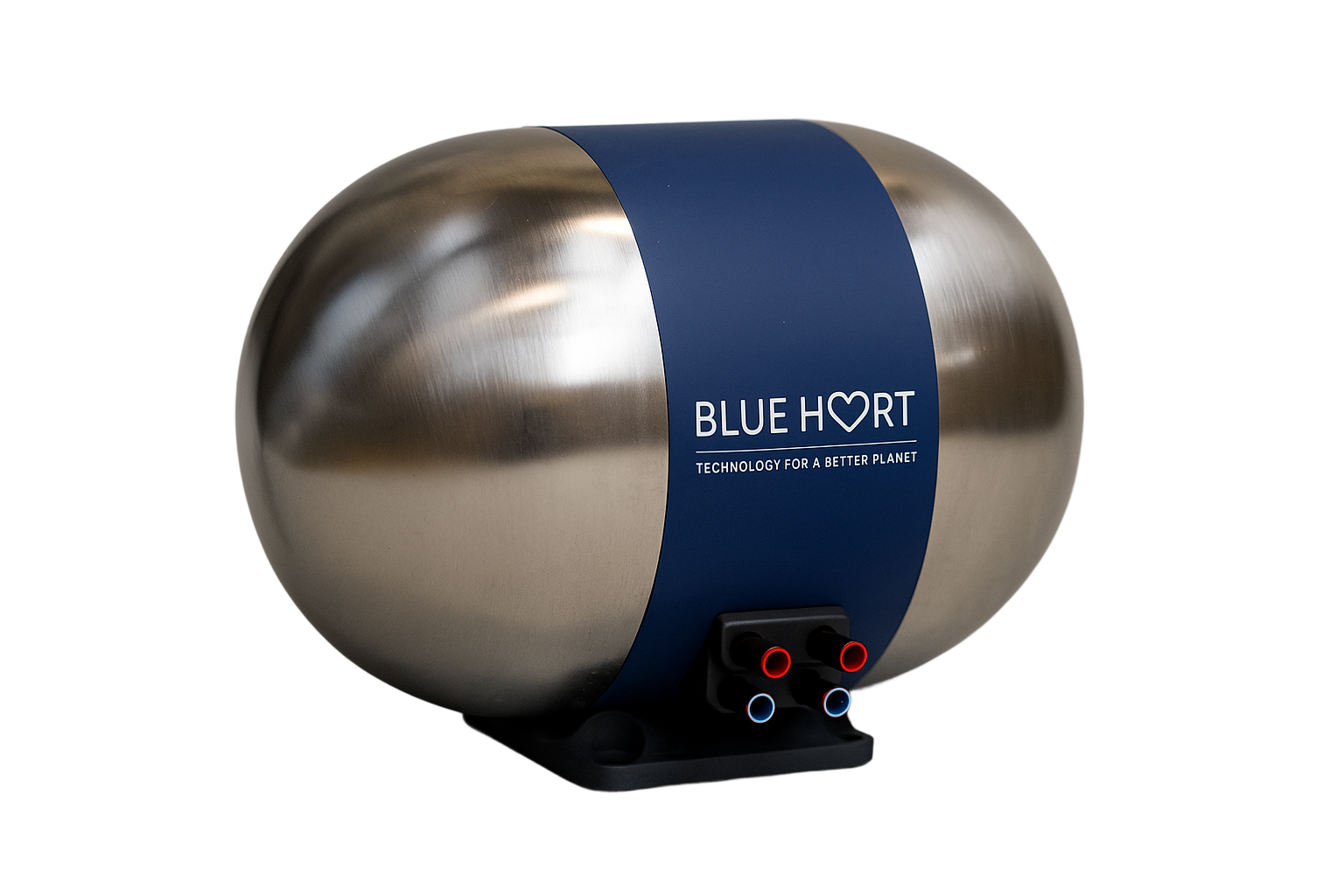
The BlueHeart thermoacoustic engine: leading the way to a zero-CO2 emission, non-flammable, and affordable heating and cooling solution for residential, commercial and industrial applications.
- Heat pumps are the most sustainable heating and cooling devices. They extract heat from a source, such as the air or the ground, and release it into the house. They do it very efficiently, by moving heat instead of directly generating it – with one unit of electricity they can deliver five units of heat.
- The standard technique used in heat pumps to transfer the heat is the vapor compression cycle. It uses the evaporation and condensation of a refrigerant to transport energy and increase temperature. The condensation point of a refrigerant is fixed and only adjustable by the filling pressure. The technique works very efficiently for temperatures around that condensation point but, the further away the temperature input and required output are from this condensation point, the lower the efficiency. The vapor compression cycle was used commercially for the first time more than 150 years ago, to produce ice making machines.
- Thermoacoustics represents a totally different approach to moving heat, using compressing and expanding Helium that always remains as a gas. Because there is no change in phase, the system is not attached to any (condensation) temperature, and it can efficiently work with every temperature input and output. This flexibility enables the standardization of heat pumps, reducing the manufacturing and installation costs. Additionally, it enables the use of heat pumps as a direct replacement of gas boilers in retrofit applications, as the high temperatures it can provide are sufficient to heat the radiators of existing houses that are typically not as well insulated as the new buildings.
- BlueHeart Energy is a worldwide leader in the field of thermoacoustic. Seeded with deep technology expertise from TNO, BlueHeart has built the foundational technology and production knowledge needed to deliver the world’s first commercial thermoacoustic heat pump. Several of the world’s top experts work for BlueHeart. They all share our vision to make the planet a better place by making thermoacoustics the standard heating and cooling technique. Every day we are closer to making our dream come true.
Watch our video
How it works
The BlueHeart Engine’s flexibility, cleanliness, and thermoacoustic technology makes it the best solution for all buildings, new, and poorly insulated. Its 0-CO2 emissions make it ideal to abide by current and future environmental regulation and concerns. Watch our video for more.
Technical
Benefits

Single-phase working gas
The BlueHeart engine uses single-phase Helium, eliminating conventional temperature boundaries tied to vapor compression refrigerants and maintaining its power at lower source temperatures.

Few moving parts- Silent
The BlueHeart utilizes few moving parts and requires no maintenance. Additionally, it contains vibration-cancelling linear drivers, which delivers silent operation of the engine (40db(A)).

100% Clean, zero-emission
The BlueHeart is an electrically driven engine that does not emit any CO2.

Speed of Sound
The internal acoustics rapidly adapt to new operating conditions, due to high speed of sound in Helium, delivering superior load response time.
We’ll explain
Why Thermoacoustics?
The BlueHeart engine is a drop-in replacement for the vapor compression circuit in traditional heat pumps. It is robust and silent by design, with few moving parts. The engine can be cascaded to increase the capacity of the heat pump for larger systems.
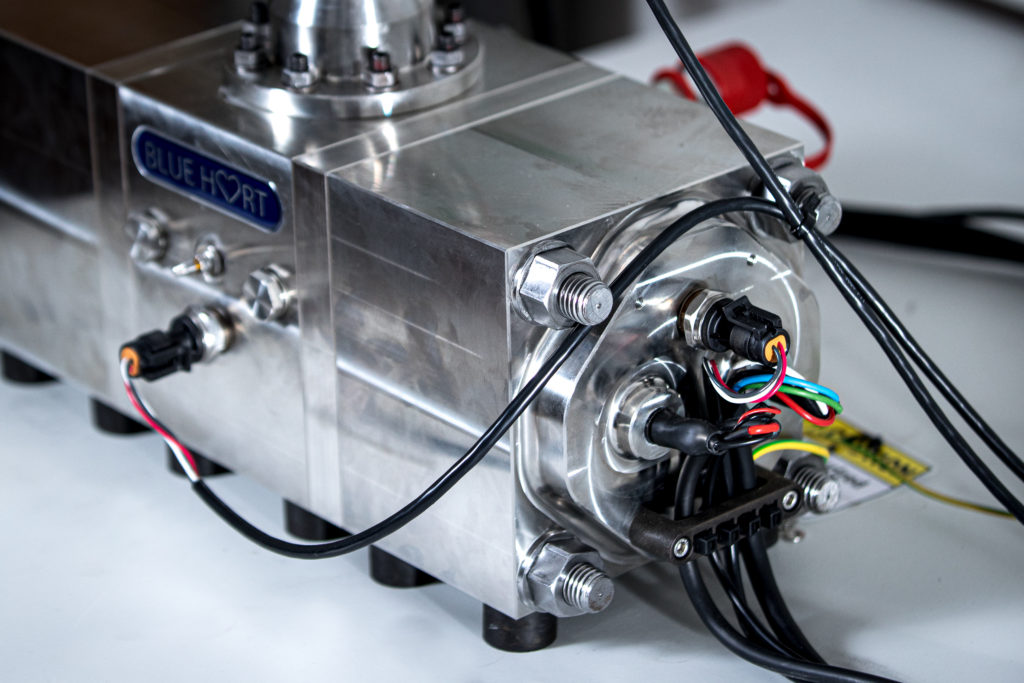
- BlueHeart’s engine concentrates heat through sound waves inside a sealed and pressurized Helium loop. The system is architected to maintain a safe and production-friendly PED category of 2.
- Inside the engine, there are two electrically-driven, vibration-cancelling linear drivers that act like loudspeakers, providing acoustic power to a thermoacoustic loop. The thermoacoustic loop uses this acoustic power as input work to move heat from the cold source to the heating sink (i.e. the heating system). Thermodynamically, the system behaves similarly to a stirling heat pump but without the use of an unbalanced displacer piston.
- The heart of the thermoacoustic loop consists of a regenerator, two heat exchangers to transfer energy to and from the external environment, and an acoustic shape to guide the acoustic waves inside the loop. The heat exchangers use water or brine, and they can be directly connected to system source heat exchangers (e.g. dry cooler, water source plate heat exchanger, PVT, etc.) and sink heat exchangers (e.g. radiator system, DHW, etc.).
- The BlueHeart engine delivers a robust, silent, and scalable solution for heating and cooling applications in residential, commercial and industrial markets, enabling streamlined production, product standardization, and maintenance-free operation.