
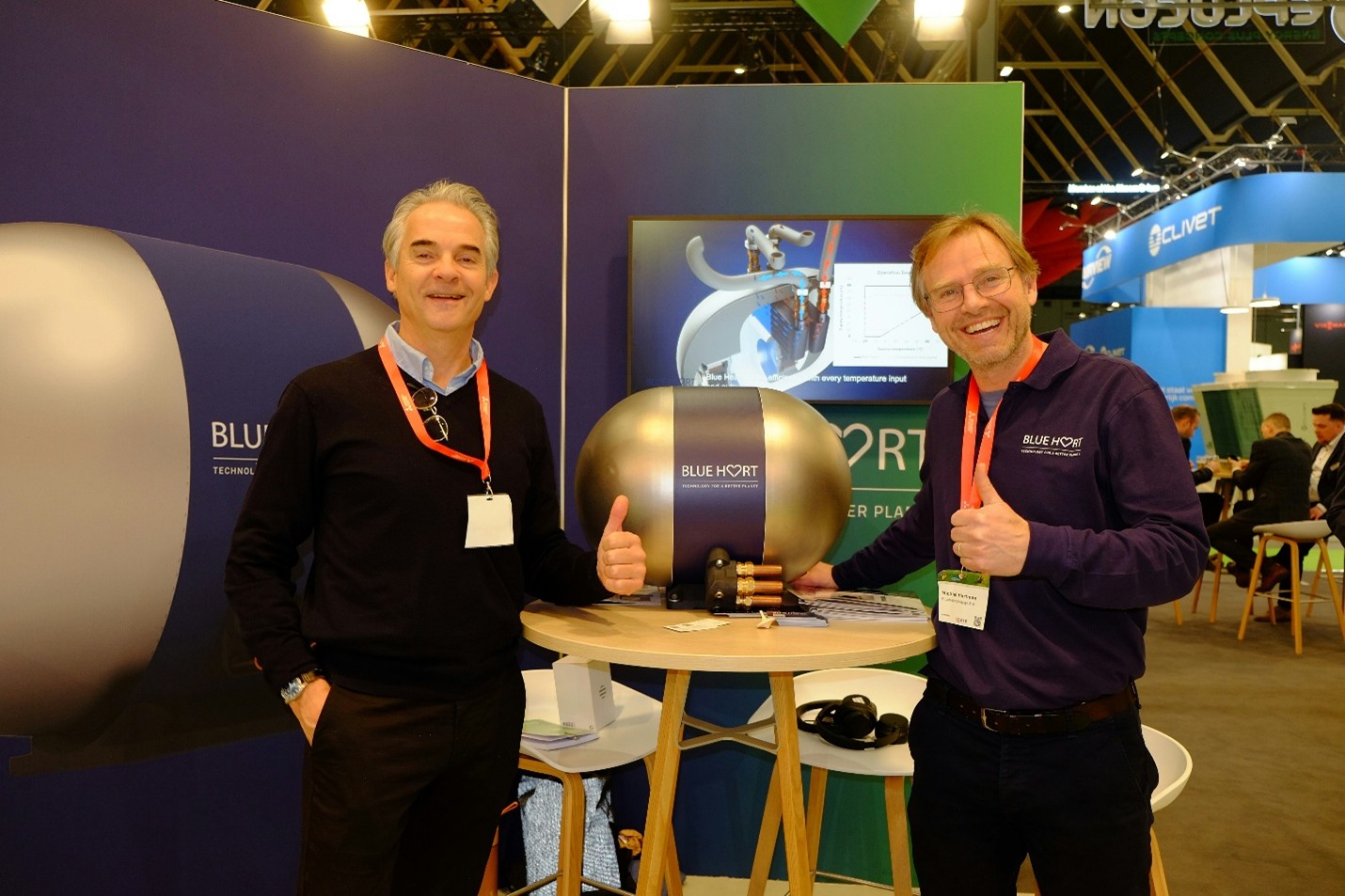
Michiel Hartman (right) and partner at BlueHeart Haico Halbesma (left) are positive that the market introduction of the thermo-acoustic heat pump (between them) will succeed.
A test of BlueHeart Energy’s thermoacoustic heat pump at a housing corporation is going well. This gives CEO Michiel Hartman confidence that the first heat pumps will appear on the market in the spring of 2027, he said on VSK+E.
BlueHeart Energy had a booth next to Eplucon at VSK+E. That location was no coincidence; The Ecoforest brand, represented in the Netherlands by Eplucon, will market the first series of heat pumps equipped with BlueHeart’s thermoacoustic engine. The company from Heemskerk will produce that engine as a semi-finished product. The engine replaces the traditional refrigerant circuit that uses a compressor, evaporator and condenser. Another company can turn this engine into a water-to-water heat pump. Ecoforest is the first to do so, but according to Hartman, other companies may follow. “They are already reporting in full.”
Trust kept
Hartman has been working on the thermoacoustic heat pump for about ten years and has announced the market introduction several times during that period. But something kept coming up; this had to do with gaps in the design. Hartman continued to develop and kept faith in a good outcome. In doing so, he found several investors, including the renowned company Copeland. Those investors are also needed for the growth and scaling of the company. To give you an idea: BlueHeart now employs over sixty people.
Field test goes well
The field test of the first Ecoforest heat pumps with thermoacoustic engine at a housing corporation is going well, according to Hartman and Hanco Folmer of Eplucon. With this, BlueHeart is now taking a serious step towards an actual market introduction. “The plan is that the Ecoforest heat pump with thermoacoustic engine inside will be ready for use by the end of this year. After that, commercial production will begin. We expect to be able to deliver the first heat pumps in the spring of 2027. Then we will scale up the production of BlueHeart,” says Hartman.
Water as a source
The thermoacoustic heat pump has a power of 6 kW, can deliver temperatures from -20°C to 80°C and can be installed indoors or outdoors. The heat pump will have to be connected to a water source. In the case of Ecoforest and Eplucon, this is a dry cooler, but a soil source or PVT, for example, is also possible. The sound output of the engine is 40 dB(A), but can be dampened by the casing of the heat pump.
The thermoacoustic engine replaces a vapor compression circuit in a heat pump, i.e. the compressor, evaporator and condenser.
Sound waves and helium
The heat pump works with sound waves and helium. By compressing helium, the heat pump generates heat, and by expanding the gas, cold is generated. According to Hartman, the advantages of this heat pump engine include the fact that it provides higher efficiency across all seasons, compared with conventional heat pumps. According to Hartman, the thermoacoustic engine can modulate just like other heat pumps. “Switching it on and off only takes a few seconds and does not affect the lifespan.”